
Design to build
Figma to WordPress
Your design built as a WordPress block theme your team can edit — not rebuilt in a page builder you have to keep licensing. The spacing, type scale and colours come out of your file, not out of a template that was close enough.
Send the Figma link. You get a written build plan back: which frames become templates, which components become patterns, anything in the file that needs a decision, and one fixed price — before you commit to anything.
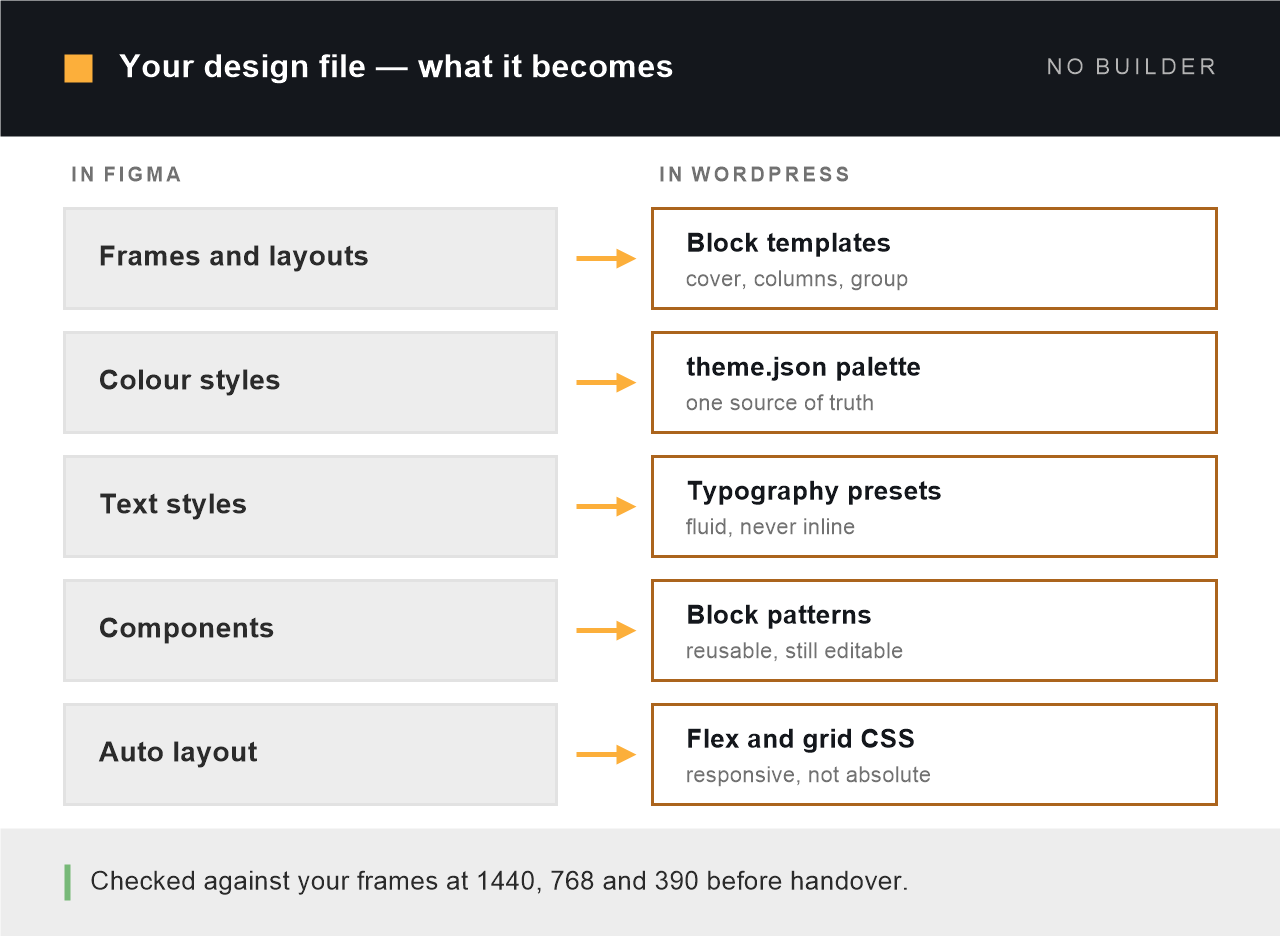
Everything in your file has a WordPress equivalent. We agree the mapping in writing before anything gets built.
$450
Starting price, fixed before any work begins
3 widths
Checked against your frames at 1440, 768 and 390
No builder
Native blocks, so there is no yearly licence to renew
30 days
Support after handover, at no extra charge
Sound familiar?
When a finished design has nowhere to go
The design is done and approved. The hard part was supposed to be over. What usually goes wrong next is not the design and not the developer — it is that nobody wrote down what each layer in the file was meant to become.
- Every quote so far has been “we will rebuild it in Elementor”, which is not what you designed
- The last build came back close but not right, and nobody can say exactly what is off
- Your developer keeps asking for spacing values that are already in the file
- Colours and type drifted during the build, so the live site no longer matches the brand guide
- It looks right at 1440 and falls apart on a phone
- Your team cannot add a new page without a designer drawing it first
- The quote assumed a premium theme and two plugin licences you never asked for
- There are forty components in the file and nobody has said which of them become reusable
The work itself
What the build covers
A block theme, built from your file, using WordPress as it is meant to work. No page builder, no private framework, nothing that stops functioning the day a licence lapses.

Frames into templates
Each page frame becomes a block template, with the header and footer as template parts so a change lands everywhere at once. Repeating page types — a service page, a post, an archive — become one template rather than five copies that will drift apart.

Styles into theme.json
Your colour styles, text styles and spacing scale become presets in theme.json. That is what stops the drift: an editor picks from your palette rather than typing a hex code, and a brand change later is one file rather than four hundred inline styles.

Components into patterns
The sections you designed once and reused — a pricing row, a testimonial band, a feature grid — become block patterns your team can insert on any page. Locked where the layout matters, editable where the words do. This is the part that replaces a page builder.

The widths you did not draw
Most files have a desktop frame and a phone frame. Real browsers sit everywhere in between. We work out what happens at 900 and 1100, show you before building it, and use fluid type and CSS grid so the layout bends rather than snapping at three fixed points.

Semantics and accessibility
A heading that looks big in the design is not automatically an H1. We build one H1 per page and a heading order that makes sense, keyboard-reachable navigation, visible focus states, real alt text, and labelled form fields. Contrast is checked against the design and we tell you if a colour pair fails.

Speed and handover
Images exported at the sizes actually used and served as WebP, fonts self-hosted and preloaded, no library loaded for one animation. Then the theme, the pattern list and a short document explaining how the site is put together, so the next developer does not need to phone us.
Before you hand over the file
What the state of your file changes
A tidy file is cheaper to build than a messy one, and the difference is worth knowing before you ask for a price. None of these are blockers. They just change what the build plan says and what it costs.
| What is in the file | What we do | Why it matters to you |
|---|---|---|
| Named colour and text styles, a spacing scale | Straight into theme.json | The fastest and cheapest possible start. Your design system survives the build instead of being flattened into one-off values. |
| Components with variants, using auto layout | Patterns and block styles | Your team gets those sections as reusable blocks. Auto layout also tells us your responsive intent, so we guess less. |
| Loose layers, no styles, values typed each time | We build the system first | We read the file, derive the palette and type scale, and send them for approval. Adds a little to the price and saves far more later. |
| Only a 1440 desktop frame | We propose the smaller widths | You approve how each section reflows before it is built, rather than seeing it for the first time on your phone after handover. |
| Effects CSS cannot reproduce exactly | Nearest equivalent, agreed first | Some Figma blends and blurs have no honest browser equivalent that is also fast. We show you the difference rather than quietly shipping something else. |
| An animated prototype | Built static, motion priced separately | Transitions and hover states are included. Scroll-driven sequences are real development work and get their own line, not a surprise. |
| Fonts not licensed for web use | Flagged before we start | Web licensing is bought by you, not us. Finding out at launch is the expensive way to learn this. |
| A design plus custom functionality | Quoted as two pieces | The build is this page. Anything the site has to do is WordPress development, priced from $900, so you can see what each part costs. |
Included as standard
What comes with every conversion
Not tiers, not upsells. These apply to a $450 landing page and a forty-page site equally.
- A written build plan before any money changes hands. Frame by frame: what becomes a template, what becomes a pattern, what needs a decision from you. Yours to keep whether or not you hire us.
- Native block theme, no page builder. No Elementor, Divi or WPBakery licence to renew, and no framework that holds your layouts hostage.
- Your styles in theme.json. Palette, type scale and spacing as presets, so the site still matches the brand guide a year from now.
- Checked side by side with your frames. At 1440, 768 and 390, section by section, before we call it done.
- Editable by your team. Patterns and locked layouts, so a content update does not become a support ticket.
- Built on staging. On a copy you can look at throughout, not a reveal at the end. Your live site is never the experiment.
- Speed considered during the build. Right-sized WebP images, self-hosted fonts, no library loaded for a single effect.
- Thirty days of support after handover. If something we built breaks, we fix it. No charge, no argument.
How it works
Frames first, price second, build third
01 — Free build plan
Send the Figma link with view access. Within two business days you get the mapping in writing — every frame, what it becomes, which components are worth making reusable, and the handful of things in the file that need a decision before anyone starts. Yours to keep either way.
02 — Fixed price
One number in USD, agreed before anything starts. A single landing page starts at $450. A five to eight page marketing site usually lands between $1,200 and $2,500. Larger sites are split into stages you can stop between.
03 — Built, checked, handed over
Built on staging where you can watch it happen. Before handover we put the build next to your frames at three widths and walk the differences with you. Then you get the theme, the patterns, the documentation and thirty days of support.
Scope, honestly
Conversions we turn down
A design conversion goes wrong in predictable ways, and most of them are visible before the work starts. If your project is on this list we will tell you on day one rather than three weeks in.
- Flattened images or PDF exports instead of an editable file — we would be guessing at every value
- Pixel-perfect fixed-width builds that ignore mobile entirely, however firmly they are asked for
- Copying another company’s live site in place of a design
- Headless front ends in React or Next.js; we do the WordPress side well and will not pretend otherwise
- Nulled or cracked premium themes as a starting point, under any circumstances
- Designs still being revised — we build once the file is signed off, not alongside the redesign
Common questions
Figma to WordPress, answered
How much does it cost to convert Figma to WordPress?
From $450. That is the floor for a single page built from a clean file with named styles. A five to eight page marketing site usually lands between $1,200 and $2,500, depending on how many distinct templates it needs rather than how many pages exist. The free build plan turns the floor into one fixed number before you commit to anything.
How long does a Figma to WordPress build take?
The build plan comes back within two business days. A single page is usually three to five working days from approval. A five to eight page site runs two to three weeks. What moves the date is rarely the page count — it is how many genuinely different layouts there are, and how quickly decisions come back on the items the plan flags.
Do you use Elementor, Divi or another page builder?
No, not for a conversion. Builders add page weight, a yearly licence and a lock-in that makes the site expensive to leave later. We build a native block theme, and your team gets the same freedom to lay out pages through patterns and the block editor. If you already run a builder site we will happily work within it — we just will not start a new build that way.
Will the site match the design exactly?
Section by section, at the widths you designed, yes — and we check it side by side before handover. Exact everywhere is a promise nobody can keep honestly: browsers render type slightly differently, and content changes length once it is real. Where a Figma effect has no fast browser equivalent we show you the difference and let you decide, rather than shipping something else quietly.
What do you need from me to start?
View access to the Figma file, the fonts or their web licences, your logo in a vector format, and whoever can answer questions about content. That is enough for the build plan. If pages are still being written we can build with the design’s placeholder text and swap it later, as long as the lengths are roughly honest.
Can my team edit the site afterwards without a developer?
That is the point of building it this way. Text, images and links are edited in the block editor. Whole sections are inserted as patterns you already have. Structural parts are locked so an accidental drag cannot break a layout. You get a short written guide covering the pieces specific to your site, and it is written for whoever updates the site, not for a developer.
I only have desktop designs. Can you handle mobile?
Yes, and it is the most common situation. We propose how each section reflows at tablet and phone widths and send that for approval before building — usually as annotated notes rather than full frames, which keeps the cost down. If you would rather draw the mobile frames yourself, that is fine too and it makes the build slightly cheaper.
Can you convert Adobe XD or Sketch files instead?
Yes. XD, Sketch and Penpot files all work the same way as long as the layers are editable and styles are named. We work in Figma daily so a Figma file is marginally faster to quote, but the price does not change. What does change the price is a flattened export with no layers, because then every value has to be measured by eye.
Does pixel accuracy make the site slow?
It should not, and it is usually the builder rather than the design that causes it. A native block theme ships far less CSS and JavaScript than a builder page. We export images at the sizes actually used, serve WebP, self-host and preload fonts, and avoid pulling in a library for one effect. If an existing site needs rescuing rather than building, that is speed optimization, from $349.
Do you work with clients outside India?
Almost all of our work is for clients in the United States, United Kingdom, Australia and the EU — often design studios who hand us the build and keep the client relationship. We are based in Rajpura, Punjab and keep hours that overlap US Eastern, UK and Australian business days. Prices are quoted and invoiced in USD.
Send us the Figma link.
You get a written build plan back — every frame, what it becomes, what needs a decision, and one fixed price. No sales call, no obligation.