
Ongoing capacity
Hire a Dedicated WordPress Developer
One named developer, working your hours, inside your tools, on your backlog. Not a ticket queue and not a different freelancer each time who has to be told the history again.
Send us the backlog, or just describe the kind of work that keeps arriving. You get a written plan of what the first month would cover and one fixed monthly price — before you commit to anything.
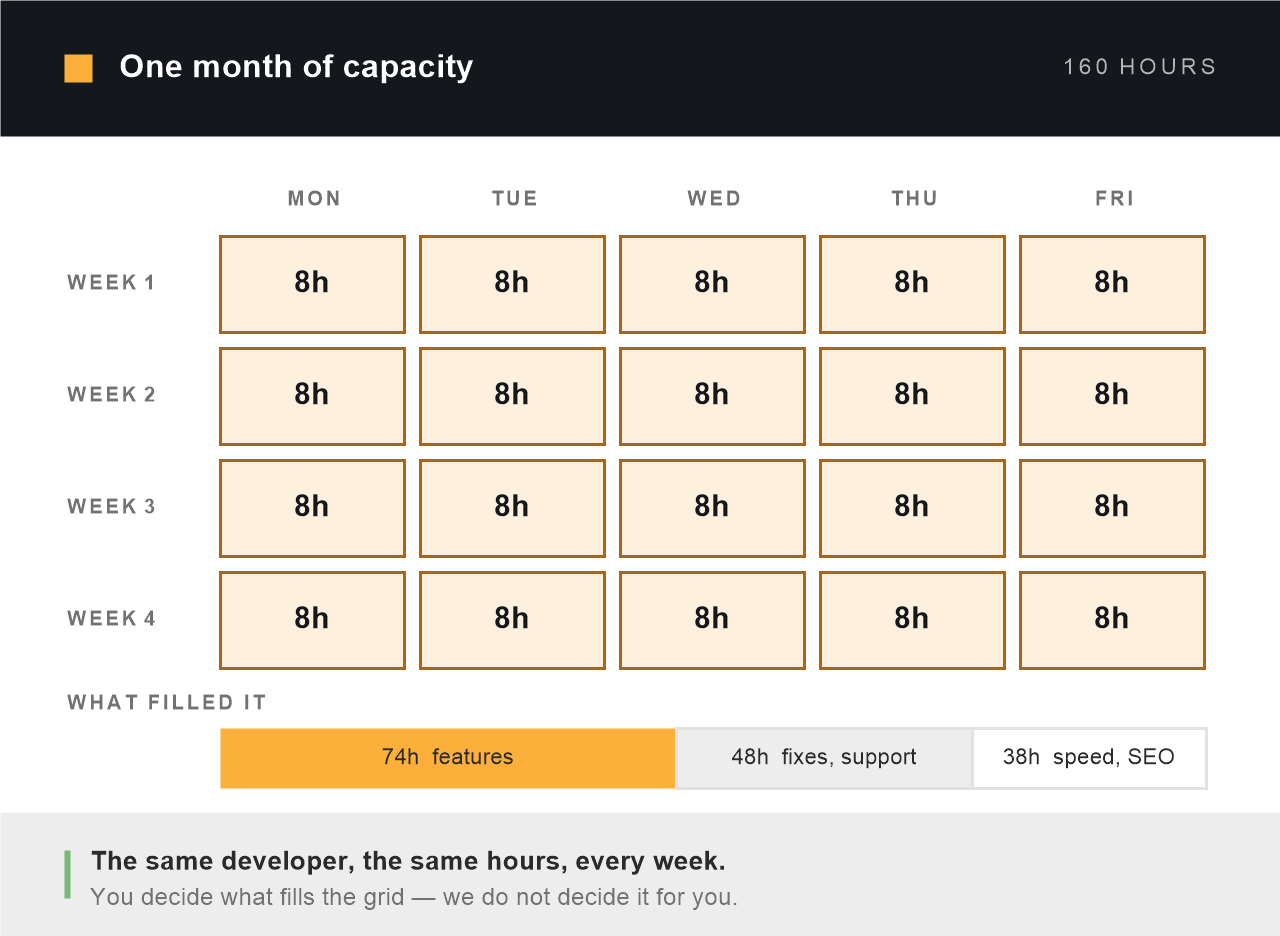
The grid is identical every month. That predictability is the thing you are buying.
$2,400
Per month, one fixed number, no recruitment fee
160 hours
A full month of one developer, not a share of several
4 hours
Minimum daily overlap with your working day
30 days
Notice to stop, scale up or scale down
Sound familiar?
When the problem is not one job
Fixed-price project work is the right answer when there is a project. It is the wrong answer when there is simply more WordPress work than people, arriving every week, in pieces too small to quote and too many to ignore.
- You are an agency winning WordPress work faster than you can staff it
- Every small change means finding a freelancer and explaining the site from scratch
- Hiring in-house takes three months and costs four times this before anyone starts
- Your last freelancer disappeared mid-project and took the context with them
- The backlog is forty small jobs, and quoting each one costs more than doing it
- Your one WordPress person is the only one who understands the site, and they want a holiday
- Work arrives in bursts and you need capacity you can turn down again
- You need someone who already knows your codebase on the Monday it breaks
How it works in practice
What you are actually getting
A retainer is easy to sell vaguely, so here is the specific version — what the person is, where they work, and what happens when reality interferes.

One named person
You get a developer, not an account. Same person next month and the month after, building up knowledge of your codebase that a rotating pool never accumulates. You see their name, their background and their recent work before you commit to anything.

Inside your process
Your Slack, your Jira or Trello, your Git repository, your branching and review rules. We do not ask you to adopt our system for one person. If you have no system, we will suggest a light one — a board, a branch per task, a weekly written summary — rather than inventing process you did not ask for.

What they can take on
Theme and plugin development, block and pattern work, WooCommerce, ACF, REST and third-party integrations, performance, migrations, and the steady stream of small fixes that nobody wants to quote for. PHP, JavaScript, MySQL and CSS to the WordPress coding standards.

Hours that overlap yours
We are in Rajpura, Punjab. The working day overlaps the whole UK and European day, the Australian afternoon, and the US Eastern morning — at least four hours of live overlap wherever you are, agreed in writing before the first month. We will not pretend a permanent night shift is sustainable, because it is not.

Up in a busy month, down in a quiet one
Full-time is the standard arrangement, but half-time works and so does adding a second developer for a heavy quarter. Thirty days’ notice in either direction, including down to nothing. The point of a retainer over a hire is that it is reversible without anybody’s redundancy process.

Cover, and a way out
A second developer is briefed on your account from the start, so illness and holidays are covered rather than announced. Work happens in your repository and your board throughout, so if you end the retainer nothing has to be extracted from us — it is already where it belongs.
Before you decide
Retainer, project work, or an actual hire?
Three ways to get WordPress work done, and a retainer is only the best of them some of the time. This is the comparison we would give you if you asked us privately.
| Dedicated developer | Project by project | Hiring in-house | |
|---|---|---|---|
| Monthly cost | From $2,400, fixed | Quoted per job, from $349 | Salary plus tax, tools, equipment and management |
| Time before work starts | Days | Days, each time | Two to four months, if the hire works out |
| Knows your codebase | Yes, and more each month | Relearns it every job | Yes, after a ramp-up you also pay for |
| Scaling down | Thirty days’ notice | Simply stop sending work | A redundancy process |
| Cover when they are away | Briefed second developer | Not applicable | You are exposed unless you hire two |
| Best when | Work arrives continuously and the pieces are too small to quote individually | There is one defined job with a clear finish line | WordPress is core to your business and you can keep somebody busy and growing for years |
If the bottom row points at hiring in-house, hire in-house. We would rather tell you that now than take a retainer you resent in six months. And if there is one clear job with an end date, the honest answer is usually fixed-price development instead.
Included as standard
What comes with every retainer
No recruitment fee, no onboarding charge, no minimum term. These apply whether you take half a developer or three.
- The developer’s name and recent work up front. You see who it is before the first invoice, not after.
- Agreed overlap hours in writing. At least four hours a day against your working day, fixed before month one.
- Work in your accounts throughout. Your repository, your hosting, your board. Nothing to extract if you leave.
- A weekly written summary. What moved, what is blocked, what needs a decision from you.
- Cover briefed from day one. A second developer who already knows the account before anybody needs them to.
- WordPress coding standards. Escaped output, sanitised input, code your own team can review.
- White-label if you are an agency. We work under your name, to your client, and stay out of the relationship.
- Thirty days’ notice, both ways. Up, down, or stopped entirely. No minimum term and no exit fee.
How it works
Backlog first, match second, work third
01 — Free written plan
Send the backlog, or describe the work that keeps arriving. Within two business days you get what the first month would realistically cover, what it would not, whether a retainer is even the right shape for it, and one fixed monthly price. Yours to keep either way.
02 — Meet the developer
You get their name, background and recent work in writing. If you want to talk to them before starting, that is a technical conversation with the person who would do the work — not a sales call with somebody who would not. If they are not the right fit, we propose someone else.
03 — First month, then a rhythm
Week one is access, environment and reading the codebase, so expect it to be the slowest. After that it settles: work from your board, a weekly written summary, and a month-end review of what the hours went on. If it is not working, thirty days’ notice and no argument.
Scope, honestly
Arrangements we turn down
Most failed retainers were badly shaped on day one rather than badly worked. These are the shapes we have learned not to agree to, however the month is priced.
- Permanent night shifts. We overlap your working day by at least four hours; we do not relocate ours entirely
- Interviewing five candidates to pick one. We propose the developer we think fits and replace them if we were wrong
- Work outside WordPress — Laravel, Node, headless React front ends
- Under forty hours a month. Below that nobody holds enough context to be worth the handover
- Retainers bought to reserve availability where no work is ever sent — you will resent the invoice and you would be right
- Being presented to your client as your employee, when nobody on your side is managing the work
Common questions
Hiring a dedicated developer, answered
How much does it cost to hire a dedicated WordPress developer?
From $2,400 a month for one full-time developer, invoiced in USD, with no recruitment fee and no minimum term. Half-time arrangements are proportionally less. What moves the price is seniority and how specialised the work is — a straightforward WordPress backlog sits at the floor, while heavy WooCommerce or integration work costs more. The written plan gives you one fixed number.
What hours will they actually work?
A normal working day in India, shifted to give you at least four hours of live overlap, agreed in writing before the first month. That covers the whole UK and European working day comfortably, the US Eastern morning, and the Australian afternoon. We will not agree a permanent night shift — people who work them burn out and leave, which is your problem as much as ours.
Is it genuinely the same person every month?
Yes. That is most of what you are paying for — a developer who knows why your site is built the way it is. A second developer is briefed on the account for cover, but they do not silently take over the work. If we ever needed to change your developer permanently, you would be told before it happened, not after.
Can I interview them first?
You can talk to them, and we encourage it — a technical conversation with the person who would actually do the work. What we do not do is put three or four candidates through an interview process to be picked between. We propose the developer we think fits your codebase and your way of working, and if we got that wrong we replace them without an argument.
What if it is not working out?
Thirty days’ notice, no exit fee, nothing to unwind. All the work has been happening in your repository, your hosting and your project board from the first week, so there is nothing of yours sitting with us to be handed back. If the problem is the person rather than the arrangement, tell us and we will propose someone else instead.
Can they work in our Slack, Jira and GitHub?
Yes, and that is the normal arrangement. Your tools, your branching rules, your review process, your stand-ups if you have them. We do not ask you to adopt anything of ours for the sake of one person. If you have no process at all we will suggest a light one, because work with no board and no branches becomes untraceable for both of us.
What happens when they are ill or on holiday?
A second developer has been briefed on your account from the start, so cover is somebody who already knows the site rather than somebody reading it for the first time in an emergency. Planned leave is flagged at least two weeks ahead. Extended absence is credited against the following month rather than quietly absorbed.
Can we white-label the developer for our agency’s clients?
Yes, and a good share of this work is for agencies. We work under your name, to your client, using your email address if you want, and we stay out of the relationship entirely — we will not approach your client during or after. What we ask is that somebody on your side owns the work, because a developer with no brief and no reviewer produces exactly what you would expect.
What kind of work can they actually take on?
Custom themes and plugins, block and pattern development, WooCommerce, ACF, REST and third-party API integrations, performance work, migrations, security hardening, and the constant stream of small fixes and content changes. PHP, JavaScript, MySQL and CSS, written to the WordPress coding standards. Anything outside WordPress is on the list of things we turn down above.
Do you work with clients outside India?
Almost all of this work is for clients in the United States, United Kingdom, Australia and the EU, and a large share of it is white-label work for agencies in those markets. We are based in Rajpura, Punjab, keep hours that overlap your working day, and quote and invoice in USD.
Send us the backlog.
You get a written plan of what the first month would cover, one fixed monthly price, and an honest answer if a retainer is the wrong shape for your work. No sales call, no obligation.