
WooCommerce
WooCommerce Development
Checkout flows, payment gateways, shipping logic and the custom work stock WooCommerce will not do. Built to survive your next catalogue import, your next plugin update, and your next December.
Send a URL and tell us what the store is doing wrong. You get a written audit back naming the cause, what it is costing you in orders, and one fixed price — before you commit to anything.
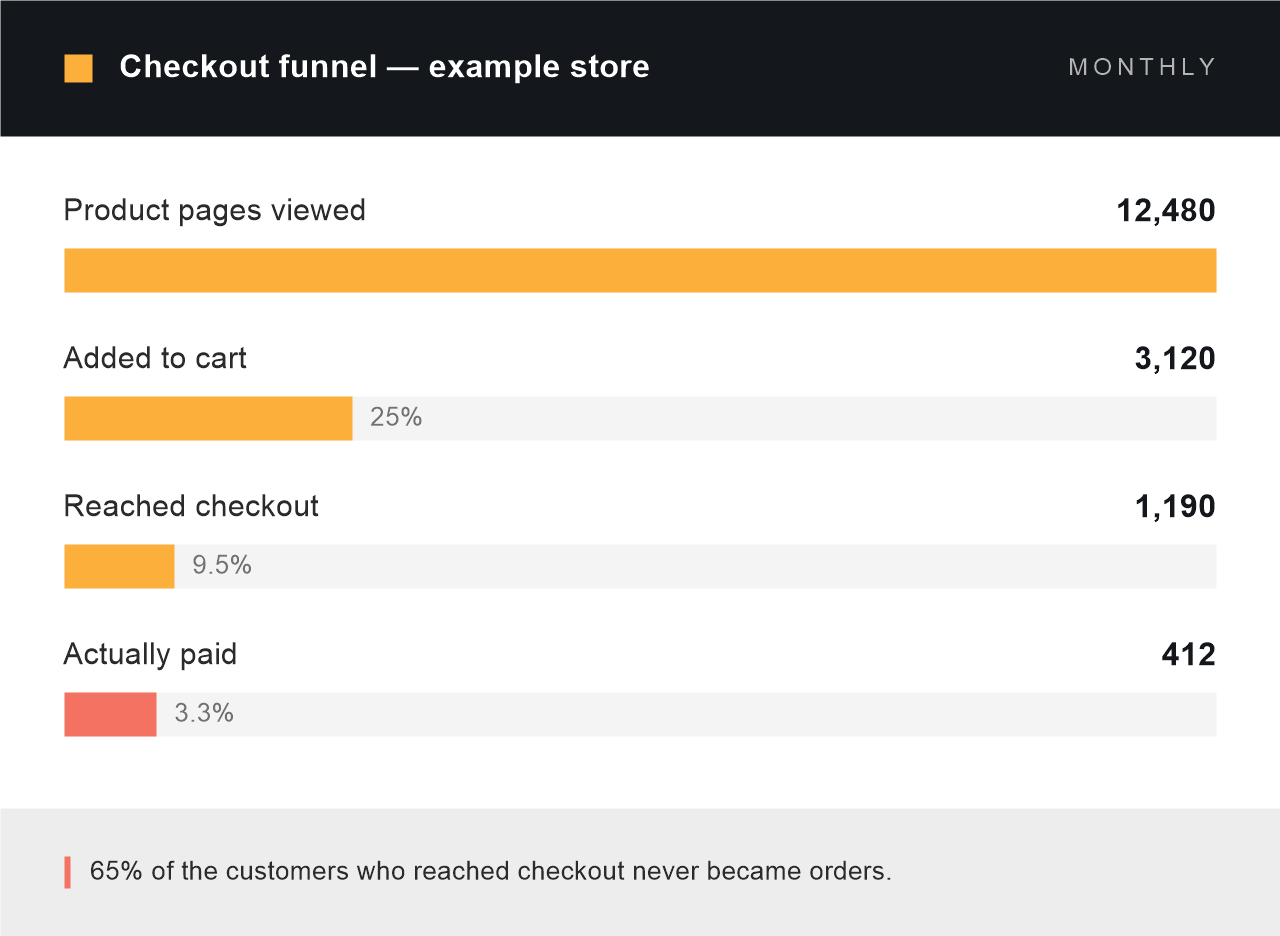
Where the money actually goes. The audit tells you which step is leaking and why.
$1,200
Starting price, fixed before any work begins
Order-tested
Cart to payment to email to refund, proven with real test orders
No lock-in
Standard WooCommerce hooks, not a private framework
30 days
Support after handover, at no extra charge
Sound familiar?
What a struggling WooCommerce store looks like
A store that loses orders rarely announces it. The traffic looks fine, the reports look fine, and the revenue quietly sits below where it should be. Every one of these has a specific cause that shows up in the audit.
- Customers reach checkout and abandon it, and nobody can reproduce why
- The store got slower every time the catalogue grew, and it is still growing
- Payments fail for some customers and go through for others
- Shipping rates come out wrong for certain postcodes and you correct them by hand
- Stock counts drift out of step with what is actually on the shelf
- A product with fifty variations takes ten seconds to load
- Every change needs the developer who built it, and they are no longer around
- You are paying yearly for six extensions that each do one small thing
The work itself
Six places a WooCommerce store needs real engineering
Most stores do not need everything on this list. The audit tells you which two or three actually apply to yours, and the price reflects that rather than a package.

Checkout that converts
Fewer steps, fewer required fields, guest checkout that works, and validation errors that say what is actually wrong instead of showing a spinner. This is usually where the largest single gain in a store’s revenue is sitting.

Payment gateways
Gateway integration, strong customer authentication handled properly, and declines, timeouts and duplicate charges treated as the three different problems they are. Regional methods too — iDEAL, Klarna, Afterpay — where your market expects them.

Shipping, tax and fulfilment
Rules that hold up across zones, weights, dimensions and the exceptions your business actually has — written as one coherent set rather than four plugins each overriding the last. Tax handled for the countries you really sell to.

Product data and variations
Variable products that stay fast past fifty variations, attributes structured so filtering works, bulk imports that do not silently drop rows, and clean feeds for Google Shopping and Meta. Boring work, and the reason a catalogue stays manageable at ten thousand products.

Performance at catalogue scale
Stores slow down for reasons brochure sites never hit: product meta queried without an index, plugins running inside the product loop, cart fragments firing on every page. We fix the database work, and exclude cart and checkout from caching so nothing goes stale where it costs you money.

Integrations that stay in step
ERP, CRM, inventory, accounting and fulfilment. Two-way sync with reconciliation and an alert when it breaks — because the expensive failure is not a sync that stops, it is a sync that stops quietly and lets you oversell for a fortnight.
Diagnosis
Where WooCommerce stores actually lose money
Find the row that sounds like your store. The cause is almost never the one people assume, which is why the audit comes before the quote rather than after it.
| What you see | Usual cause | What we change |
|---|---|---|
| Customers reach checkout and do not pay | Too many required fields, forced account creation, or a payment step that fails silently on mobile. | Cut the form to what is legally needed, allow guest checkout, and surface the real error instead of a spinner. |
| The store slows as the catalogue grows | Unindexed product meta, plugins querying inside the product loop, and an options table that has grown unchecked. | Index what is queried, cache what repeats, and remove the extension doing it in a loop. Overlaps with speed optimization. |
| Payments fail for some cards and not others | Strong customer authentication not implemented, or a gateway timing out with no retry path. | Handle the authentication step properly, and treat declines, timeouts and duplicates as separate cases with separate outcomes. |
| Shipping rates come out wrong | Rules assembled by stacking plugins that each override the last, until nobody can say which one is deciding. | Replace the stack with one readable set of rules, and test them against the postcodes that were failing. |
| Stock drifts away from the warehouse | A one-way or scheduled sync that failed silently, sometimes weeks ago. | Two-way sync with reconciliation, plus alerting so a broken sync is noticed the same day. |
| Variable products crawl | Every variation loaded up front on page load, along with prices for all of them. | Load variations on demand and cut what the page ships before the customer has chosen anything. |
Included as standard
What comes with every store job
Not tiers, not upsells. A live store is somebody’s income, and these apply whatever the job costs.
- A written audit before any money changes hands. What is wrong, what it is costing in orders, and what fixing it involves. Yours to keep either way.
- Real test orders, end to end. Cart, checkout, payment, confirmation email, stock decrement and refund — tested, not assumed.
- Staging first. Built and tested on a copy of your store with a copy of your data. Your live store is never the experiment.
- Your orders and customers untouched. We work around live data rather than through it, and take a backup before anything runs.
- No lock-in. Standard WooCommerce hooks and a child theme — not a private framework only we can maintain.
- Fewer plugins where we can manage it. Replacing four extensions with fifty lines of code is a normal outcome, not an upsell.
- Documentation in plain language. What changed, why, and what your next developer needs to know before touching it.
- Thirty days of support after handover. If something we touched breaks, we fix it. No charge, no argument.
How it works
Diagnosis first, price second, work third
01 — Free written audit
You send a URL and describe what the store is doing wrong. We walk the buying journey as a customer would, then look underneath it. You get a written document naming the cause and what it is costing. Yours to keep whether or not you hire us.
02 — Fixed price
One number in USD, agreed before anything starts, with the scope in writing. Most store work lands between $1,200 and $6,000. Larger builds are broken into stages you can stop between, so you are never committed to the whole thing on day one.
03 — Built, order-tested, handed over
Built on staging, proven with real test orders through every payment method you accept, then deployed at a time that suits your trading hours. You get documentation and thirty days of support.
Scope, honestly
Store work we turn down
We would rather lose the enquiry than take a project we would do badly. If yours is on this list we will say so on day one and, where we can, point you at someone who does it properly.
- Stores that are not WooCommerce — no Shopify, Magento or BigCommerce work
- Multi-vendor marketplaces built from scratch; we will maintain an existing one
- Dropshipping automation and supplier-scraping setups
- Rebuilding subscription billing from scratch when a maintained extension already does it
- “Copy this competitor’s store exactly” — we will build what your business needs instead
- Nulled or cracked premium extensions, under any circumstances
Common questions
WooCommerce development, answered
How much does WooCommerce development cost?
From $1,200. That is the floor for a defined piece of work — a checkout rebuild, a gateway integration, a shipping logic overhaul. Most store projects land between $1,200 and $6,000. Full builds and multi-system integrations go higher, and get broken into stages you can stop between. The free audit turns the floor into one real number before you commit.
How long does it take?
The audit comes back within two business days. A single piece of work — checkout, a gateway, shipping rules — is usually one to two weeks. Larger builds run four to eight, staged so you see working software throughout rather than a reveal at the end. A store that is actively losing orders gets triaged first; say so in your message.
Will you break my live store?
Everything is built on a staging copy with a copy of your data, and proven with real test orders through every payment method you accept before it goes near production. Deployment happens at a time that suits your trading hours, not ours. We take a full backup first, and we do not run untested migrations against live order data.
Can you work with my existing theme or page builder?
Yes. We regularly work on stores built with Elementor, Divi, Astra, Flatsome and WooCommerce’s own block themes. We will not rip out your builder as part of a store job. If it is genuinely the thing standing in the way, we say so, price that separately, and let you decide.
My store is just slow. Is that this service or speed optimization?
Usually WordPress Speed Optimization, and it starts at $349 rather than $1,200 — so it is worth asking before assuming you need the bigger job. It becomes store development when the fix requires changing how the store works rather than how it loads: rewriting a query a plugin generates, or replacing an extension that cannot be made fast. The audit tells you which, and we quote the cheaper one where it applies.
Can you migrate my store from Shopify?
Yes — products, variations, customers, order history and URL redirects so your rankings survive the move. That is quoted under WordPress Migration when it is purely a move, and under this service when the store needs building properly on arrival rather than transplanting as-is. Most Shopify moves are a bit of both, and the audit says which parts fall where.
Do you build subscriptions and memberships?
Yes, normally on top of the maintained extensions rather than from scratch — recurring billing is a solved problem and rewriting it is how stores end up with payment bugs nobody can trace. What we do build is the custom logic around it: proration rules, plan changes, dunning behaviour and the reporting your finance side actually needs.
What happens after launch?
Thirty days of support are included — if something we touched breaks, we fix it at no charge. After that you can come back per job, or put the store on WordPress Maintenance & Care so updates are tested on staging before they reach a live checkout. Stores are the one case where we genuinely think untested auto-updates are a bad idea.
Do you work with clients outside India?
Almost all of our work is for clients in the United States, United Kingdom, Australia and the EU. We are based in Rajpura, Punjab and keep hours that overlap US Eastern, UK and Australian business days. Prices are quoted and invoiced in USD.
Tell us what the store is doing wrong.
Send a URL and a sentence about where it is losing orders. You get a written audit back with the cause, what it is costing, and one fixed price — no sales call, no obligation, no retainer pitch.